
The interest in this study began on Christmas eve when my grandmother read something she wrote out loud, it was titled “What it means to grow old.”. My grandmother raised issues and stereotypes by eloquently written punch lines and moving words of wisdom. I am embarrassed to say that it was then I realized I had consider my grandmother as that, my grandmother, not Odette Fontaine, which is who she is not what she is. It sparked an interest in the identities of an older generation that our society seemingly pays little attention to. I had already spoken to Sian Stevenson before Christmas break about the possibility of a placement with her company Moving Memory. With my grandmother’s letter as a last motivation, my decision was made.
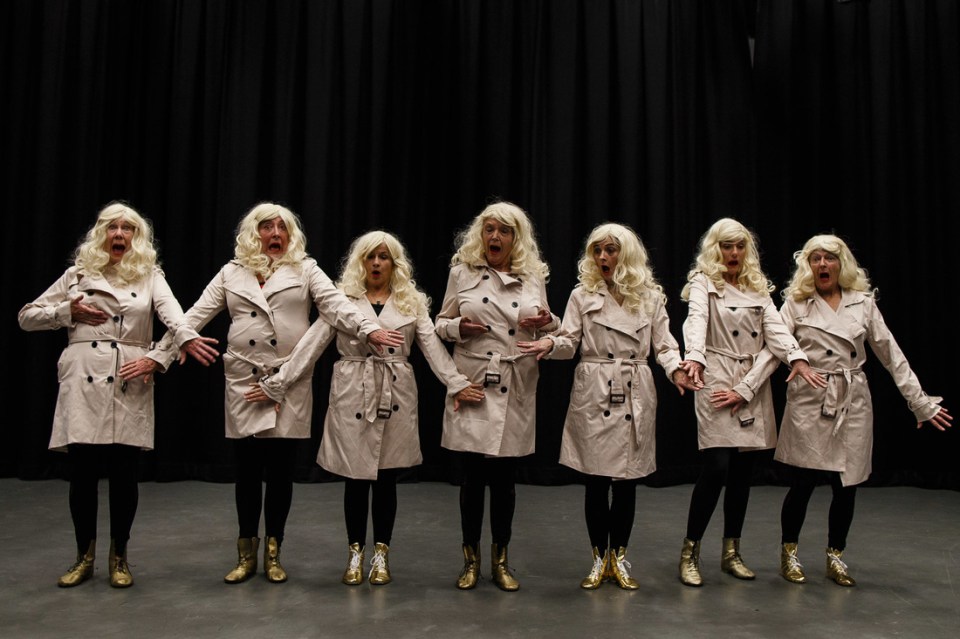
Moving memory is a dance company where its core members are exclusively female and aged between 53 and 83. It was founded by Sian Stevenson, who is the artistic director, and Jayne Thompson 6 years ago. The company emerged as a follow on Stevenson’s previous work with older people called Ballroominating. It is safe to say that the company is socially engaging. Because society often sets a double standard for women’s bodies, especially women’s aged bodies, this presentation will focus mainly on the female aged body.
1. Perceptions of older women in Western society
In her article The body, gender and age: feminist insights in social gerontology, Julia Twigg quotes Gulette by saying “we are aged by culture“, and additionally questions the role of the body in this.[1] Before I raise the issues surrounding the female aged body, I want to tackle the term ageism to create a general context around age in our society. Ageism is a term introduced by Robert Butler. It allows us to dehumanize older adults and view them as a social problem, an ‘other’.[2] We are judged not by how old we are, but how young we are not. Youth is the desired beauty norm within Western society. To state it more specifically, if we gain privilege by how much social currency we possess, meaning how close we come to the norm, one could say that growing old is a constant defiance of that normalcy and therefore as we grow older we lose social currency. [3]
How does the body and more specifically the female body fit into all this? Twigg states when talking about the role of the body in gerontology that, “Within western culture, to emphasize the bodily can be to reduce or lessen an individual(…)”.[4] So when modern personhood rests on the possession of a clearly defined and bounded body, and you do not possess such a body or are perceived as such, you are lessened as an individual. [5] When speaking about the female body, Twigg continues by saying that “(…) there has been a long history of misogynistic discourse in which women are denigrated by reducing them to their bodily characteristics.”. [6]This is where the double standard for the female body comes in. Women throughout their lives learn that their social currency or their traditional source of power depends largely on their body, and the function of that body,[7] which to oversimplify it, is to be desired, or aesthetically evaluated[8] and to procreate. Male power by contrast resides in money, status, social dominance.[9] He can be seen as a wiser more mature man. For a woman, to not be desirable or aesthetically pleasing is punished further as our society provides them with all sorts of creams, treatments, ‘health’ courses to retain that beauty norm as long as they can. Youth is to be consumed and purchased, so when one deviates from the beauty norm, it is in fact their responsibility that this has happened. Consumer culture is in fact youth culture in that it presents and promotes youthfulness as the ideal.[10] The second criteria, after menopause is irreversible and cannot be avoided. So, the double standard lies in that they not only deviate from the beauty norm by aging alone, but lose the possibility to be an aesthetically evaluated individual, even more so when society lays the blame of ageing not with the inability to stay young but with their renunciation of youth. In one of my last rehearsals, I was speaking to the core members about their portraits. One member shrugged and grimaced when talking about hers and said “I have too many wrinkles.” Her wrinkles in my opinion added to her aesthetic. Wrinkles are an example of something that deviates from the beauty norm and is labeled as unhealthy and ugly.
On my first day with Moving Memory as I am helping Sian Stevenson bringing the constumes to the rehearsal studio, she tells me “You know one of the hardest things is to find constumes for these real fleshed older women that are also comfortable.”[11] I have just spoken about our consumer culture being quintessentially youth culture. Not only in how we view youth as an ideal but how our economy aims at a particular target audience, young people. It is no wonder that Sian would find it difficult to find clothes as our whole society is tailored to the body of youth.
What I would like to discuss further is how this representation affect the opportunities given to the company. In an interview with Sian Stevenson she states that, “At first it was very difficult, because the audience expectations is that they will be playing old nice grannies. They expect people to do amateur dramatics. It is difficult to sell it to venues, because they think the audience is going to be very limited and artistically it won’t fit their program.”[12]
2. Breaking perceptions
The aged body and its aesthetics
How can the perceptions about age I have previously raised be challenged?
I am a firm believer of the power of creative space and that a first step is to put a body, which is less represented in our society’s mainstream and art specific landscape, in a different context. To put a body in a performative space, especially a body that we do not expect to find there, we manage to change the perceptions of that body and allow the aged body to reclaim its personhood. By being on stage we are given a voice, which in Moving Memory is very important. The core members of Moving Memory have all one thing in common they are all politically engaged. They all have something to say about their bodies, their age and their gender. Feminism is very important and a deal breaker for new members. This platform gives them a chance not only to ‘preach to the choir’ when speaking amongst themselves but to tell their stories to a broader public.
This step, important as it may be, is not enough. When putting aged bodies on stage it is important to keep stereotypes and expectations these bodies embody, in mind. In an interview with a company member she states that, “I want to give a good performance, not something second rate and forgivable just because we’re old.”[13] The quality of the work is a priority.
The first rehearsal I sat in on, I was enamored by the warm up alone. Yes, it is quite embarrassing that it had had such an impact on me, as if I had never seen such a thing, but truth be told I hadn’t. I hadn’t seen a group of older women move together in such a way, with so much expression. They ended their rehearsal with practicing their dance ‘Hard’, which had an even bigger impact. Not only did it contradict my expectations of how older women are supposed to act, but it reminded me these are people, they are sexual, they are political, they are not defined by their disabilities. I was so happy when I returned home having experienced this, thinking yes all the stereotypes are wrong, and we shouldn’t pigeonhole people in such a way just because of number. Then after a few hours of contemplation, I found myself in a conflicting conversation with myself. Yes indeed, they ‘can’ do this, and yes, they do defy stereotypes by moving with so much expression, confidence and sex appeal, but I realized that a sense of personhood should not rely only on these norms. Not moving for example can be active, silence can speak volumes and less can be more.
There are two problems here, one is that certain qualities are only attributed to youth and that these qualities could not be embodied by an aged body, the second is that certain disabilities that come with an aged body are perceived with no quality at all.
Nanako Nakajima writes in her article ‘De-aging dancerism? The aging body in contemporary and community dance’ about perceived disabilities that come with age, such as memory loss, or loss of motor function, can be a source of creativity.[14] Your aged body perceived as a disabled body can actually be an asset. Nakajima states that “when dancers become old and lose control over their bodies, their bodies lead and their minds follow.”[15] The body in this informs the mind, and therefore is able to have an experience that goes beyond conscious thought.[16] Nakajima gives the example of Kazuo Ohno. She states that by forgetting what he learned, he managed to make his performances highly improvisational[17] and therefore authentic. Moving Memory is a company that started out with untrained bodies, now though five years later I cannot say that they are untrained because they are not. Remembering choreography can be a struggle, but can be source of creativity. It gives new opportunities. When they are doing something ‘wrong’, it can be a great source of innovation within the choreography that they are learning.
In one of the last rehearsal I sat in on, and by now participated with, I stood behind the curtains with one of the members, waiting for our cue. We were giggling behind the curtains waiting to go into the space and just as it was her cue, she looked at me and said “I can’t even remember what I’m supposed to do, but I’ll just make it up as I go.” The obstacle of memory can be a great source of creativity as in allows for more spontaneity, authenticity and for the members to explore more movements without getting stuck in one mindset. In another rehearsal one of the company members said when told to go up from a crouched position, that she couldn’t do that. She wouldn’t be able to do that, so she worked with different levels by playing on the ground and allowed them to consider different angles within their choreography.
Moving Memory not only breaks perceptions about age but about disabilities in general. It is contemporary in that it does not approach dance and choreography it a traditional way, but rather in a postdramatic way. In the 60s the Judson theater company changed the perceptions of what dance was. Simply walking became dance, and you could find the extraordinary in the ordinary. Moving Memory certainly does that, especially in their dance Kitchen, where they employ their own daily movements that relate to a certain memory. One of my favorite quotes is Sian telling them “Look up as if your husband has just walked through the door.”[18] To dismantle stereotypes, you must know how it is mantled in the first place. By using irony they show us how these ridiculous stereotypes towards women and age are mantled.
Another way they defy stereotypes is by using technology. In a workshop I was introduced to ‘Doris.’ Doris is a computer software they use for creating choreography or using it in their performances. For example it outlines them and by stripping them from any individuality, it strips them from perceptions as well and at the same time humanizes them by using that confrontation between the virtual body and fleshed body.
Conclusion
So my question was “Does the aged body on stage reshape perceptions about age in Western society?” and my answer is a resounding yes. It does, certainly if, like Moving Memory, the work is not only socially engaging but they aim to create quality art with minorities and not on them.
What I have retained from my time with Moving Memory is their use of memory and their limits as a source of inspiration.
Bibliography
- TWIGG, The body, gender and age: Feminist insights in social gerontology, 2004
- TWIGG, Adjusting the cut: fashion, the body and age on the UK high street, 2012
- BAKER, ageing in public, 2016
- WHITE, Applied theatre aesthetics, 2015
- NAKAJIMA, De-aging Dancerism? The aging body in contemporary and community dance, 2011
- R. LEVY & J. L. MACDONALD, Progress on understanding Ageism
- H. CLARKE, Women growing older in anti-aging culture, 2011
- HOLLEDGE & J. TOMPKINS, Women’s intercultural performance, (London: Routledge, 2000)
- Interviews with company members + (participatory) observation of rehearsals and performances
References
[1] J. TWIGG, The body, gender, and age: Feminist insights in social gerontology, Journal of Aging studies 18 (2004), p. 59-73
[2]H. CLARKE, Women growing older in anti-aging culture, 2011, p. 28
[3] Ibid., p. 29
[4] TWIGG, The body, gender, and age: Feminist insights in social gerontology, Journal of Aging studies 18 (2004), p. 60
[5] Ibid., p. 66
[6] Ibid., p. 61
[7] H. CLARKE, Women growing older in anti-aging culture, 2011. p. 23
[8] Ibid., p 29.
[9] TWIGG, The body, gender, and age: Feminist insights in social gerontology, Journal of Aging studies 18 (2004, p. 67
[10] Ibid.,p. 61
[11] Interview with Sian Stevenson
[12] Interview with Sian Stevenson, 27th April 2016
[13] Interview with Glin, 5th May 2016
[14] N. Nakajima, De-aging dancerism? The aging body in contemporary and community dance
[15] Ibid., p. 102
[16] Ibid.
[17] Ibid., p. 103
 Céline Deveux